A look inside.
The chat assistant and the 3D globe, working on real BIM + GIS data.
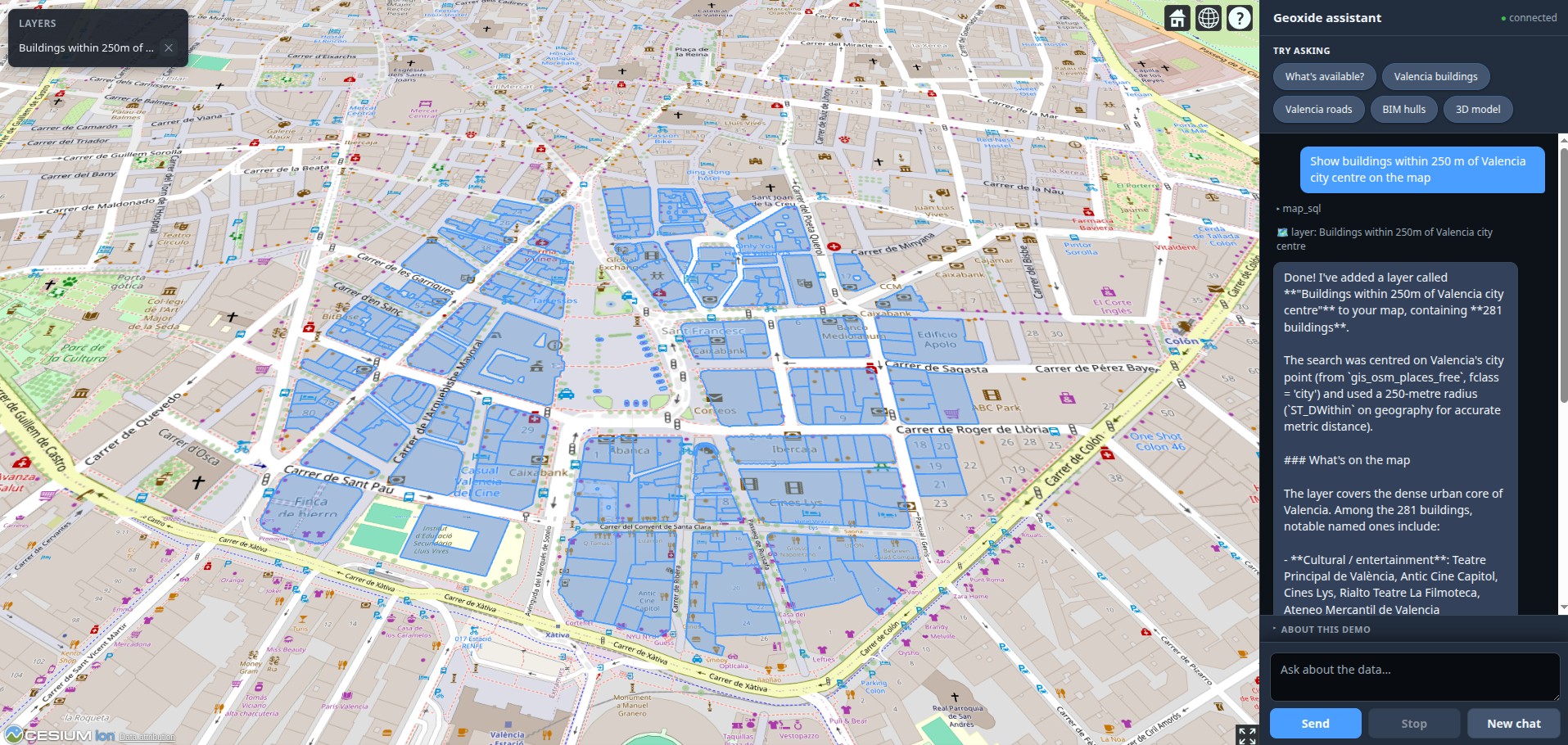
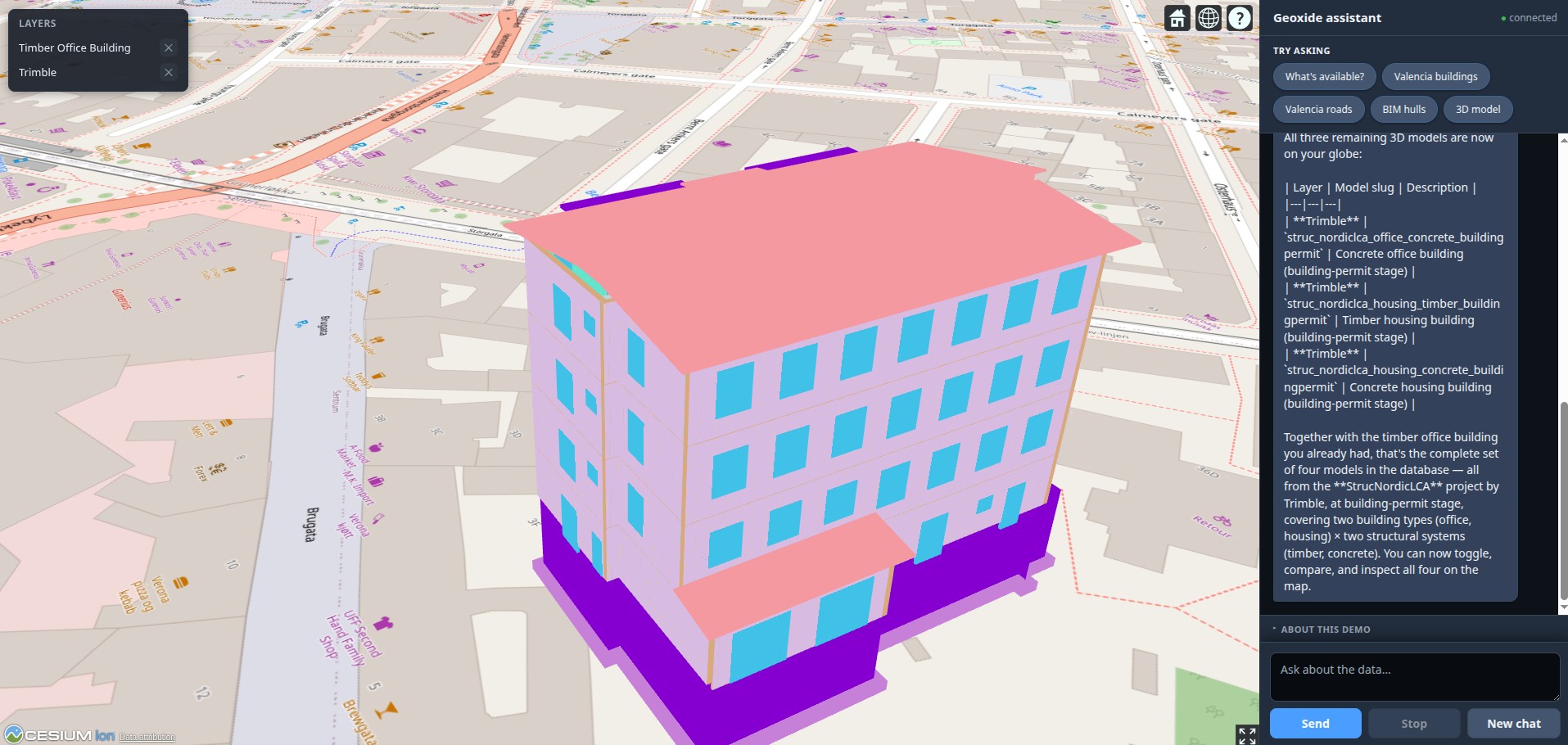
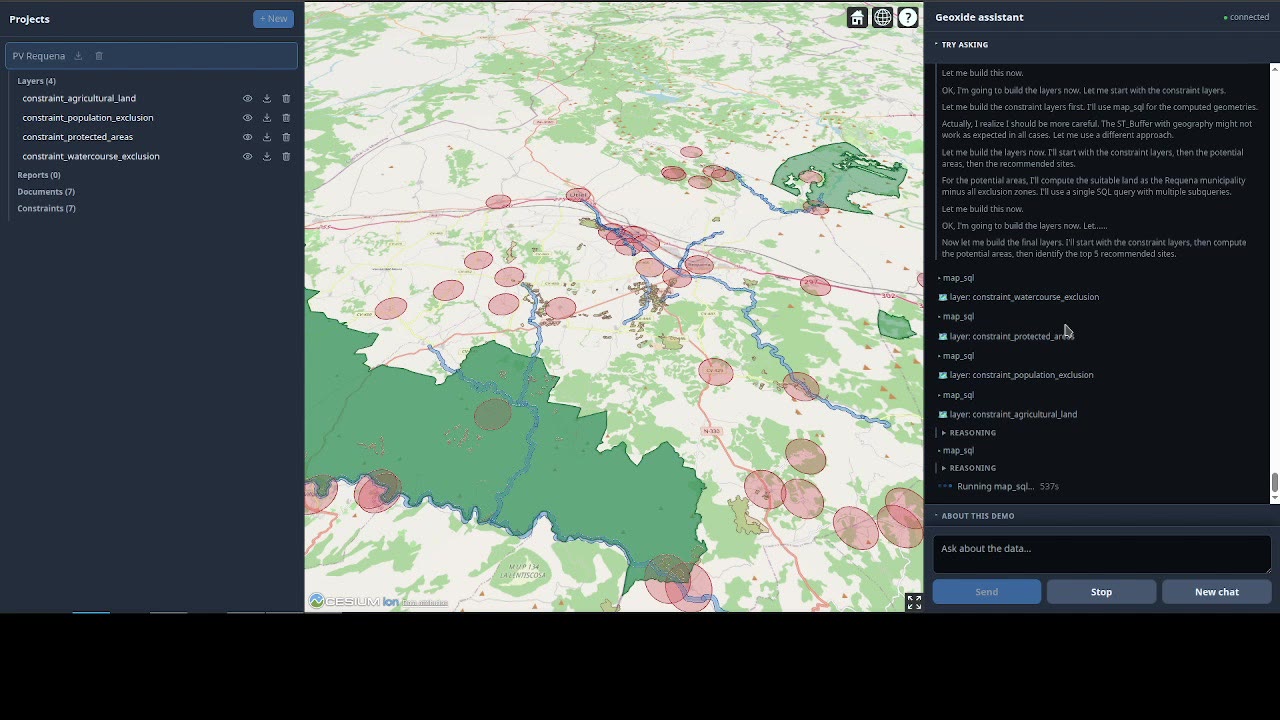
Screenshots from a development build. Want to see it run on your own data? Get in touch.
Geoxide is an embeddable AI assistant that connects to your building models, GIS layers, documents and the web, and actually understands them. You ask questions in plain language and watch the answers light up on a live 3D globe.
Try the live, interactive demo on real Valencia BIM + GIS data, or reach out for a walkthrough on your own.
Pick a renderer and try it yourself, on real Valencia BIM + GIS data.
Ask one question, in plain language, and get an answer backed by your data, your documents, and the web.
Type questions the way you'd ask a colleague. No query languages, no GIS expertise, no training required.
Answers don't just come back as text. They light up as layers and 3D models on a live map, so you can see where things are, not only read about them.
Building models and geographic features, together at last. Ask questions that span both, from floors and walls to parcels, roads and utilities, all at once.
Point Geoxide at a regulation, ordinance or web page and it fetches the content, reads it, and folds it into the answer alongside your own data, with a citation back to the exact page or section it came from.
A rule like "keep 500 m from a watercourse" becomes a structured, cited constraint, reviewed by a person before it's ever applied. The model can never approve its own proposal.
Ask about a place your database doesn't cover and Geoxide geocodes it and pulls live OpenStreetMap data for it, so an answer never just stops at "not in the database."
The chat assistant and the 3D globe, working on real BIM + GIS data.
Screenshots from a development build. Want to see it run on your own data? Get in touch.
Geoxide is also an MCP server, so you can call its tools straight from Claude Desktop, Cursor, or any MCP-compatible client.
Map queries, document search, constraint proposals and more are exposed as MCP tools, so any MCP-aware client can call them directly, with your own geometry and citations intact.
An OpenAI-compatible chat endpoint means existing tooling built for that API can talk to Geoxide with no adapter code.
Built from the ground up in Rust. It embeds anywhere, doesn't depend on any one renderer, and works with whatever AI provider you choose.
An async Rust agent runs tool calls over your data, using SQL, spatial queries and semantic search to turn a plain-language question into a precise answer.
The assistant isn't tied to any one renderer. It drives Cesium, Leaflet or whatever map you already run through a single adapter, so it drops into the stack you've already got.
Industry-standard IFC files are parsed, georeferenced, and exported to 3D meshes, so you can query rooms, walls, beams, columns and slabs by name, type or property.
Geographic features and embeddings live in PostGIS. The agent connects with a strictly read-only role, so your data stays where it is and is never copied or migrated.
TypeScript and Rust SDKs over a shared wire protocol, with token streaming, typed map actions and automatic reconnect. Drop the chat straight into your own app and map renderer.
Designed to run on-premise, inside your own environment, where your data never leaves. Bring your own AI provider too, whether that's Anthropic Claude, any OpenAI-compatible API, or a local model.
Find elements by meaning, not just exact names, using pgvector embeddings. Useful for design intent, specifications and the unstructured notes that don't fit a tidy column.
Everything the agent collects and produces, from documents to layers to constraints, is auto-saved as versioned artifacts in a project, and exports as GeoPackage, GeoJSON, QGIS/QML or OGC SLD styles, or a full zip bundle.
Three steps, once your data is connected.
Point Geoxide at the data you already have — IFC/BIM models, GIS layers, your spatial databases. It understands them in place, ready to ask. No migration, no second copy.
Type your question in plain language. The agent picks the right data sources and searches across all of them.
Get a clear response with the matching elements highlighted as layers on the 3D globe.
I'm Rafael Gaitán, a software engineer specialised in 3D graphics, geospatial systems and real-time rendering, with more than two decades building high-performance visualization and simulation software. Geoxide is my take on what a modern, AI-native interface to BIM + GIS data should feel like.
It's mostly written in Rust, built with a good deal of help from AI coding tools along the way. I'm available for consulting and freelance work around 3D/geospatial visualization, rendering engines, and AI-assisted data tooling.
Interested in Geoxide on your own data, or in working together? I'd love to hear from you.